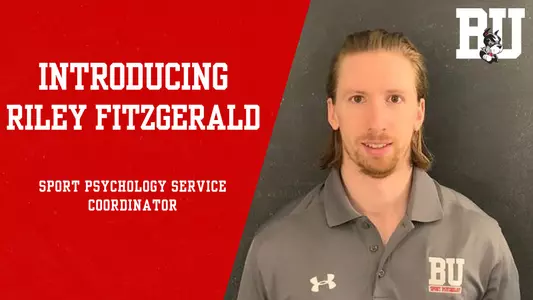
Riley Fitzgerald Focused on Bringing Out the Best in Terrier Athletes
September 1, 2020 | Sports Performance and Wellness
Riley Fitzgerald is the sport psychology service coordinator at Boston University Athletics, which means he plays an important role in how the Terriers perform both athletically and academically. Below is a Q&A with Fitzgerald which delves into both his background in sport psychology and how he plans to serve BU student-athletes.
What is your background in sport psychology and what led you to BU?
I first came to BU in the fall of 2014 for my master's degree in sport psychology and ended up sticking around for my doctorate. I've spent the past six years working with a wide array of athletes and teams in addition to serving as a coach educator for organizations like Massachusetts Hockey and the Institute for Rowing Leadership. While I've worked with numerous BU student-athletes over the past four years, a majority of my time (prior to my current role here) was spent creating and implementing sport psychology services and programming at Endicott College.
When I was approached last summer about the coordinator role at BU, it was an easy decision. I've been a Terrier for a while now and I take pride in working with our student-athletes. The role also presented a new and exciting challenge that has enabled me to really leverage my background in creating and expanding sport psychology services.
What are some of your goals for the sport psychology unit with BU Athletics? What do you hope to accomplish here?
This is my second year as coordinator of sport psychology services at BU, which really speaks to how much work was going on behind the scenes last year between the sport psychology team and Athletics to get us to this point. Our biggest goal, first and foremost, is to make sure that student-athletes and coaches know that we're here to support them. We're continuing to develop and roll out new services in an effort to meet the unique needs and interests of our student-athletes. Our hope is that there is a little bit of something for everyone who is interested in strengthening their mental game.
What are some of the ways you'll be helping our athletes?
Building a strong mental game can help athletes create a competitive advantage. Traditionally, people tend to think of sport psychology as a valuable resource for "getting back on track" when they aren't performing well. While this is certainly true, we're also here to help athletes who are playing well and want to take their game to the next level. A bulk of our work is done with student-athletes on an individual basis, where we meet one-on-one. But we do a lot of work with (and are available to) coaches and whole teams, as well. We're also rolling out some new programming this year including collaborative workshops with the Bloom Family Leadership Academy. So definitely stay tuned for what's to come!
How important is sport psychology, especially for student-athletes on fall teams during this time when there are no games?
Student-athletes are dealing with such a unique and difficult situation. Processing the loss of a season is overwhelming enough in more typical circumstances (such as injury). There are so many additional unknowns involved with COVID-19 that impact every area of life, making the situation even tougher. With how much is outside of an athlete's control right now, staying engaged with things like training, academics, professional development, and one's social life can definitely be daunting. As a result, I believe that sport psychology is extremely beneficial right now for fall sport student-athletes. We can be a useful resource for coping with and processing the sense of loss, managing related stress and uncertainty, staying motivated and engaged despite not having games, and beyond.
Has your approach to sport psychology changed during this pandemic?
Without a doubt. The work that we're doing with our teams and athletes has centered, in large part, around the uncertainty and constant changes that have come with the pandemic. We're clearly in uncharted territory here. Between canceled seasons, new guidelines for training and practices, ever-changing return-to-play timelines, and the general challenges to well-being that come with a pandemic… there have been a ton of factors at play that most of us – student-athletes, coaches, and staff alike – have never experienced before. So, we're doing a lot of work right now that isn't traditional performance enhancement but is relevant and necessary to performance and well-being all the same.
Do you think your work with athletes helps them with their academic work as well?
Absolutely. While our work is sport-performance specific, the skills that we help our athletes develop are also valuable away from sport. Attentional control and focus, stress management, building resilience, and managing performance anxiety are a few examples of the skills that our athletes have utilized in the classroom.
Is your work sport-specific, or is it more general for athletes in any sport?
Both myself and the rest of the BUSP team are available to all athletes and teams.
You also lectured at the Questrom School of Business – what did you teach and what was it like to work with non-athletes in an academic setting?
Within Questrom, I taught (and helped redesign the course content for) Dynamics of Leading People and Organizations. Other courses that I've taught in the past include Sport & Exercise Psychology and Foundations of Health Education, both of which are housed within Wheelock. Similar to my work in athletic settings, I genuinely enjoy connecting with my students and creating an environment that authentically integrates their interests, experiences, and goals with course content.
What is your background in sport psychology and what led you to BU?
I first came to BU in the fall of 2014 for my master's degree in sport psychology and ended up sticking around for my doctorate. I've spent the past six years working with a wide array of athletes and teams in addition to serving as a coach educator for organizations like Massachusetts Hockey and the Institute for Rowing Leadership. While I've worked with numerous BU student-athletes over the past four years, a majority of my time (prior to my current role here) was spent creating and implementing sport psychology services and programming at Endicott College.
When I was approached last summer about the coordinator role at BU, it was an easy decision. I've been a Terrier for a while now and I take pride in working with our student-athletes. The role also presented a new and exciting challenge that has enabled me to really leverage my background in creating and expanding sport psychology services.
What are some of your goals for the sport psychology unit with BU Athletics? What do you hope to accomplish here?
This is my second year as coordinator of sport psychology services at BU, which really speaks to how much work was going on behind the scenes last year between the sport psychology team and Athletics to get us to this point. Our biggest goal, first and foremost, is to make sure that student-athletes and coaches know that we're here to support them. We're continuing to develop and roll out new services in an effort to meet the unique needs and interests of our student-athletes. Our hope is that there is a little bit of something for everyone who is interested in strengthening their mental game.
What are some of the ways you'll be helping our athletes?
Building a strong mental game can help athletes create a competitive advantage. Traditionally, people tend to think of sport psychology as a valuable resource for "getting back on track" when they aren't performing well. While this is certainly true, we're also here to help athletes who are playing well and want to take their game to the next level. A bulk of our work is done with student-athletes on an individual basis, where we meet one-on-one. But we do a lot of work with (and are available to) coaches and whole teams, as well. We're also rolling out some new programming this year including collaborative workshops with the Bloom Family Leadership Academy. So definitely stay tuned for what's to come!
How important is sport psychology, especially for student-athletes on fall teams during this time when there are no games?
Student-athletes are dealing with such a unique and difficult situation. Processing the loss of a season is overwhelming enough in more typical circumstances (such as injury). There are so many additional unknowns involved with COVID-19 that impact every area of life, making the situation even tougher. With how much is outside of an athlete's control right now, staying engaged with things like training, academics, professional development, and one's social life can definitely be daunting. As a result, I believe that sport psychology is extremely beneficial right now for fall sport student-athletes. We can be a useful resource for coping with and processing the sense of loss, managing related stress and uncertainty, staying motivated and engaged despite not having games, and beyond.
Has your approach to sport psychology changed during this pandemic?
Without a doubt. The work that we're doing with our teams and athletes has centered, in large part, around the uncertainty and constant changes that have come with the pandemic. We're clearly in uncharted territory here. Between canceled seasons, new guidelines for training and practices, ever-changing return-to-play timelines, and the general challenges to well-being that come with a pandemic… there have been a ton of factors at play that most of us – student-athletes, coaches, and staff alike – have never experienced before. So, we're doing a lot of work right now that isn't traditional performance enhancement but is relevant and necessary to performance and well-being all the same.
Do you think your work with athletes helps them with their academic work as well?
Absolutely. While our work is sport-performance specific, the skills that we help our athletes develop are also valuable away from sport. Attentional control and focus, stress management, building resilience, and managing performance anxiety are a few examples of the skills that our athletes have utilized in the classroom.
Is your work sport-specific, or is it more general for athletes in any sport?
Both myself and the rest of the BUSP team are available to all athletes and teams.
You also lectured at the Questrom School of Business – what did you teach and what was it like to work with non-athletes in an academic setting?
Within Questrom, I taught (and helped redesign the course content for) Dynamics of Leading People and Organizations. Other courses that I've taught in the past include Sport & Exercise Psychology and Foundations of Health Education, both of which are housed within Wheelock. Similar to my work in athletic settings, I genuinely enjoy connecting with my students and creating an environment that authentically integrates their interests, experiences, and goals with course content.

Thursday, October 01
Monday, September 28
Wednesday, September 23
Saturday, September 19