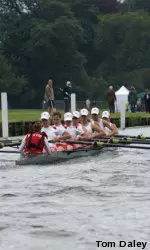
Women's Rowing Previews 2009 Spring Season
February 18, 2009 | Women's Rowing
Feb. 18, 2009
Four members from the 2008-09 Boston University women's rowing team - Alaina Krumbach, Kayla O'Rourke, Lee-Ann Persse and coxswain Alex Thornton - answered questions previewing the upcoming spring season. They discuss having a new head coach, the experience of participating in world renowned events held in Boston and what the Terriers need to do to reach the NCAAs amongst other topics.
The squad first compete on March 28 against Syracuse, but first, some of the women will compete at the World Indoor Rowing Championships, which will be held Sunday, Feb. 22, at Agganis Arena. Click here for more information on the event.
Q: So far you've spent only a few months with head coach Stacey Rippetoe. What's it been like for you having a new head coach on the team?
Alaina: So far the transition has been seamless; I attribute this to the positivity, openness, and willingness of both my teammates as well as the new coaching staff. There has been a respect and understanding from both sides and the healthy and positive attitude has been, is, and will be reflected in our results.
Kayla: The team has accepted and responded to the new coaching staff really positively. Stacey has done a lot in the past few months to get our team on track for a successful season, and I can't think of a better way to start to my final season here at BU.
Alex: The team has made a really great transition with the new coaching staff. We came into last season excited and ready to go, and I think this mentality is still with us today as we're testing our limits. Coach Rippetoe's enthusiasm and positive mentality is contagious, and my teammates and I have been able to trust and respond well to her plan.
Q: How special is it as a rower living in Boston to be able to participate in the Head of the Charles and then have the Indoor Rowing Championships held on campus as well? Do you enjoy being able to interact with athletes from around the world?
Lee-Ann: We are obviously extremely lucky to have our boathouse situated on the Charles River. It is the perfect place to train and obviously we have the benefit of rowing in The Head of the Charles Regatta and having the stat line right in front of our dock. It's always nice to meet rowers from around the world and see different perspectives of the sport. It really inspires me to want to row internationally amongst some of the best in the world.
Alex: When I was in high school, Head of the Charles was the culmination of our season. I was lucky enough to be able to race in it twice before coming to BU, and would visualize and dream about the course when I wasn't here. Since Head of the Charles is considered to be a `coxswain's race' (because of all the turns- take a look at the map on hocr.org... there's a 90 degree turn to port at Weeks bridge), each time I race the course the pressure is on to make the tightest turn or straightest course possible. Being able to practice on what's considered `THE' course is a really big advantage. Not only am I able to perfect my course, but the rowers also have an advantage because they know where they are on the course at all times.
Kayla: It is pretty exciting to have all of these famous, international events right in our city. Competing with rowers outside of our usual college setting is an experience that not every team gets. Being on a team with 9 international teammates allows me to interact with athletes from around the world on a daily basis.
Alaina: As a rower it is a special experience to participate in one of the world's biggest rowing events, the Head of the Charles. However, as a collegiate rower I find more meaningful races in the spring, as the races in the spring determine your place in the college circuit. As for the Indoor Rowing Championships, I think it is a great place for rowers and ergers to participate in such an international, adrenaline pumped arena, but as collegiate rower, it is more inspiring to me at the start line of a race with 8 other teammates all racing for BU. As for the international aspect, I have been fortunate to row and become close friends with rowers on the team from other countries; I enjoy the personal bonds I share more with them than I would ever be able to experience at Head of the Charles or Crash B's.
Q: Kayla and Alaina, were you surprised when you were picked as team captains? What are your responsibilities with the position and how do you want to help the squad succeed this spring?
Kayla: As much as I was surprised, I was also honored that my teammates chose me for this position. Along with my co-captain Alaina, our main responsibilities are to keep the team motivated, make sure the team and the coaches are on the same page about the training program, and to set the example of what being a BU rower entails. I think that the team has a great opportunity to be successful this spring, so we just have to make sure everyone is doing their part to make this happen.
Alaina: I was honored to be selected as a team captain. There were a lot of girls who put their names into the captain pool, and each brought a leadership role. So to be picked with Kayla by my teammates out of the other captain hopefuls was honoring. I think Kayla and I are an approachable and obvious link to the team and coaches. We both support our team's needs as well as promote the training program. As captains it is also our job to spark the cohesion of the novice and varsity squads. Keeping this positive open environment, in addition to unifying the two teams under the women's rowing umbrella is hopefully the right foundation to set the team up for success in the spring season.
Q: What do you feel you still need to improve on as rower?
Kayla: I think that my rowing technique is where I still need to improve the most, as is the case with a majority of the team right now. We have all been training really hard this winter season and our training program has gotten us into excellent physical shape. We are really anxious for the river to unfreeze, so we can start rowing on the water again and work on the technique that will play a huge part in increasing our boat speed.
Alaina: I think every rower's response here would be technique. There is always a need as a rower to blend more with your teammates, and that starts with everyone doing the same thing; which all boils down to doing the same technique.
Q: Outside the Head of the Charles, is there any particular race you look most forward to, particularly in the spring?
Alaina: I think the one that hits a lot of us at Boston University is the Beanpot. This race marks your status on the Charles River. We constantly see other teams training on the water, so when the chance comes for us to all go head to head, it excites us all to race for our spot on the Charles.
Kayla: The Head of the Charles is always a fun race to compete in during the fall, but the spring is filled with all of the races that really count for our season. I am really looking forward to our first race (March 28th vs. Syracuse) because I'm anxious to start racing and kick off the season. Also, the Beanpot is always fun because we get to race against all the other teams in the Boston area that we share a river with and it's always good competition.
Lee-Ann: Well our first race against Syracuse is always an exciting one, but I think Eastern Sprints is the most exciting. We get to race a lot of colleges and this is an important regatta for deciding if we go to NCAA's or not. But Eastern Sprints is always good because we know we are fit and ready to race.
Alex: I think this spring I'm really looking forward to racing at the Charles River Challenge. It'll be on our home course and we'll be racing both teams from Boston and outside of our region that haven't really looked at us in the past. I think that we're faster than we think we are, and I'm getting anxious to get on the water to prove it.
Q: Lee-Ann, What did you learn during your time participating in the 2006 Junior National Team trials and then later at the South African Under-23 trials in June 2007? Is it your goal to participate in the 2012 Olympics?
Lee-Ann: I would say that I was very young then and didn't have much experience but trained hard for both trials and unfortunately did not make the team either time. I definitely began to learn during these trials what it takes to be an international rower and its not for the faint hearted. It's a lot of dedication and hard training. It really does consume your life and that's why rowers are so passionate because if they weren't they would never be able to last. All the training I have ever done has made me a stronger person, and I am not sure what I would do if I did not have rowing in my life.
I would love to row in the 2012 Olympics and it is currently a long-term goal of mine. But at the moment I'm jus taking everything one day at a time and doing everything I can for my team at BU, because we all are training really hard and taking strides forward everyday as a team.
Q: Alaina, coming all the way from California, what has your experience been like so far living in Boston?
Alaina: Boston has been a seamless transition for me. I would take California's weather any day over Boston's, but I couldn't have asked for a better environment; the college town meets the biggest sports appreciation city.
Q: Kayla, what convinced you to take up rowing as a sport since you didn't participate in it during high school? Also, with you graduating in the spring, what are some of your favorite memories you'll take away from your time here? What are your plans after graduation?
Kayla: I participated in sports throughout high school and knew I had to find something once I got to BU to keep myself busy and active. One of the first days of school freshman year, my teammate Kelsea Gusk approached me and said something like, "You're tall...have you ever considered rowing?" I thought it was a crazy idea because I knew absolutely nothing about the sport, but I decided to give it a try and I fell in love with it.
I am actually staying here at BU for a 5th year to finish off with a Masters degree in speech-language pathology, so it will be weird to still be here in Boston and not be rowing. I think my favorite memories from the past 4 years are my amazing teammates and the experiences we've shared, both on and off the water.
Q: Alex, how did you come to the decision to be a coxswain? What do you enjoy about the role? Did you ever consider becoming a rower?
Alex: The true story is that I really wanted to be on my high school soccer team, but I didn't think I was good enough to play. My sister was the head crew coach at the time and was a coxswain when she rowed. I decided to join the team, and because I already knew a bit about the sport and I was the smallest, I was doomed to be a coxswain from the first day. I have two older sisters that rowed when they were in high school. At the time they were rowing, there was a race that I went to with my grandparents.As much as I love regattas now, when you're not racing, they can seem to be pretty boring, especially in the fall because they're head-race style. One boat at a time races down the course and you cannot tell who is winning until the race is over.
Anyway, my sisters raced in Parkersburg and it was raining, cold, and all-around disgusting that day. I was about 8 at the time, and was forced to go to a glass museum with my grandparents all day. After that experience I vowed I would never be on a rowing team. But, when I got to high school and joined the team, I was hooked and haven't been able to give it up since.
It's hard to pinpoint exactly what part of coxing I love so much. When we're sitting at the starting line of a spring race and the starter says `Attention, Go,' I'm in my zone. My voice drops an octave or two and it is game on. The best feeling is making a call in the boat that really makes a difference to the rowers. That surge of speed is addicting and keeps me coming back for more. At the end of a race, knowing that I did everything to squeeze out every bit of energy from my rowers is the best satisfaction.
Q: Alex, is there anything you feel you still need to improve on as a coxswain? Is there any difference being on an 8 boat or a 4 boat?
Alex: As a coxswain, I think that I can always continue to improve my steering. It's crucial in the spring to be able to stay on the straightest and therefore shortest course possible. Since we haven't been able to get on the water yet this season, I've had to focus on other areas of improvement. I'm trying to develop some new calls to motivate the rowers.
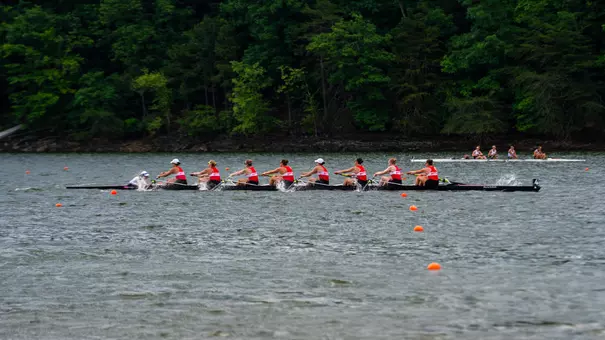
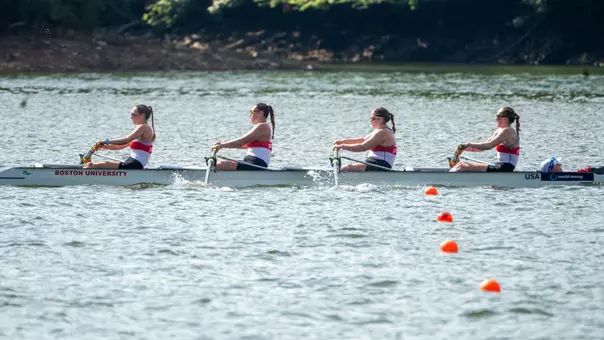
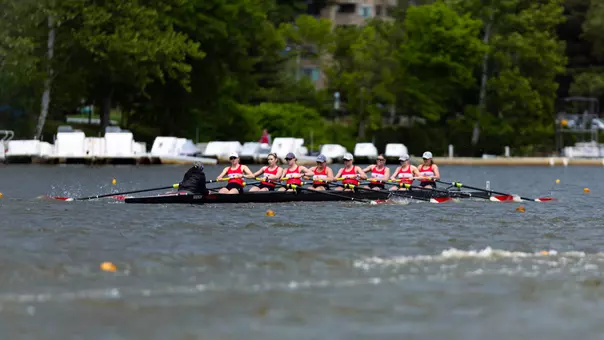
Also, learning about Coach Rippetoe's technique has been the most beneficial to me as a coxswain, because then I am able to relay it to the rowers better. I find coxing a 4 is a lot more personal than coxing an 8. There are fewer rowers and it's easier to call out technical changes that the rowers should make. Also, most of the racing 4's are bow-loaded, meaning that I sit in the hull of the boat in front of the bow seat. It's easier to steer in a four because I'm staring down the course, but in the 8, I'm in the stern of the boat and it is easier for me to see exactly what the rowers are doing, and where other boats are in the race.
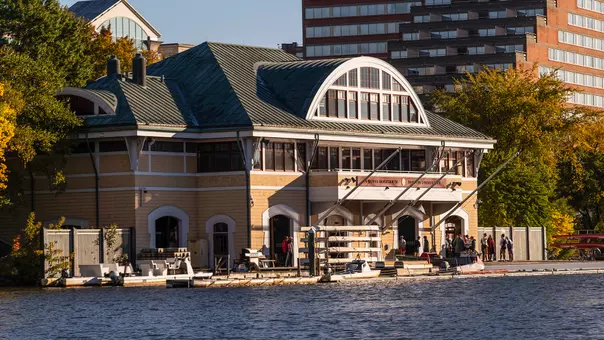
Q: What's it like for the team to be able to call the DeWolfe Boathouse home? What makes it so special?
Lee-Ann: Well really it's just that we train there every day and a boat house almost becomes like another home because of all the time you spend in it. All the hard work and training I a beautiful boathouse with awesome facilities is always a positive thing. But really when you row out of a boathouse for so long it just becomes a part of who you are because of al the memories you make there!
Alaina: You cannot beat DeWolfe Boathouse's location; not only in Boston but also on the Charles River. The boathouse is conveniently located on campus, and allows both the guys and girls teams to successfully carry out practice on and off water, host and attend races on the Charles, and call somewhere else on campus home.
Alex: DeWolfe is a great place to train. Not only is it really beautiful, but we're the starting line for the biggest head race in the world. We have these three words hanging up in the boathouse: Desire, Determination, and Dedication. Coach Rippetoe has really taken to incorporating these words into our training, and it has helped to bring us together as a team.
Q: What will the team need to do this spring to compete at the NCAA Championships?
Alaina: I think the main thing would be a positive, competitive mind set. I think with Coach Rippatoe's training schedule, we are all becoming more confident in our physical fitness and strength and I think the biggest tool for us will be carrying this knowledge we are gaining off the water in winter season to our races on the water in the spring.
Kayla: I think that right now we are all dedicated to making this a really successful season, but in order to compete at the NCAA Championship we need the drive to win and a competitive mentality. In the past couple of weeks of winter training, our entire team has really been pushing ourselves to this next level, so I'm looking forward to seeing where our hard work and dedication will take us.
Lee-Ann: The team has already started to make important changes, but the most important thing is that we have to be proud of being a part of BU and knowing that we train just as hard as everyone else and are ready to attack every race with everything we have. The mot important thing for us is to have the right mindset 100% of the time and train and race to our full potential.
Alex: The winter training has really helped each of us to find our limits. I think we need to keep pushing for more and testing just how fast we can go. Some of us are finding that we're faster than we ever thought, and it's scary. As long as we stay committed to our training program and have the drive to win, we'll get the results we want for this spring. It's important for our spring season that we overcome this fear and to believe that we're going to be the fastest team on the water.