Friday Feature: Taking It In Stride
May 6, 2011 | Women's Track & Field
May 6, 2011
By Scott Weighart, Special to GoTerriers.com
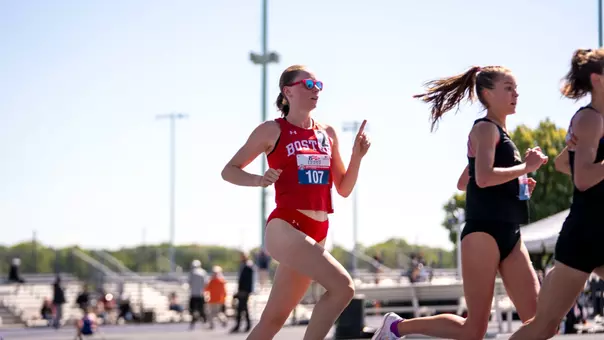
At the Terrier Invitational back in January, Boston University junior Katie Matthews blew away her personal best in the 5K, running a time of 16:13. That was over a minute faster than she had ever run.
The only problem was that it wasn’t good enough—not if the Rocky Hill, Conn., native wanted to take another giant step forward by qualifying for the NCAA indoor championships at Texas A&M in March. She would need to run a time of 16:07 at the America East championships to make the cut.
In the view of long-time coach Bruce Lehane, it appeared to be a near impossible feat. “At the Terrier meet, you run against high-quality competition. Typically, people are setting the pace, and you’re just following. We call it ‘being pulled.’ Well, at America East, the next-best athlete had no shot at that sort of time, so she was going to have to do everything herself.
“On top of that, she was lapping people by 10-11 laps into the race. So she had to swing wide to avoid people, which adds distance and breaks your rhythm. As you’re getting tired and your rhythm breaks, it’s harder and harder to get back into gear. So I just assumed it couldn’t happen.”
Just to add more adversity into the equation, Matthews suffered a personal loss at the end of January. “My grandma passed away,” she says. “If that hadn’t happened, I’d still be able to run that time. That doesn’t affect my training. At that race, I really wanted to qualify for indoor nationals. My dad had been coming to the meets, and it was his mother who passed away.
I really wanted to run well—not for him, but I knew if he could watch me race well it would mean a lot to him. That helped me think ‘I can run these times; I’m not going to fall apart.’ I didn’t want it to affect me negatively, so I put it out of my mind for the race. I just really wanted to hit that time to make it to nationals.”
“Most people, when they’re in an emotional state, they can’t run effectively,” Lehane says. “It just breaks them down. There are some rare people who go the other way, and they throw everything into it.”
Matthews got off to a great start in the race, but Lehane uses financial analogies to explain why he didn’t sense that anything special was brewing. “Early on it’s easy,” he says. “It’s like you’re writing checks. Later on, the checks come due, and you have to have the cash. So she wrote some big checks early on, but that’s easy. It doesn’t matter; anyone can start fast.
“At first, I’m not taking it too seriously. It’s right about two miles that the bill comes due. It’s like you’re running up a credit card, and now it’s time to pay it. If you can’t pay, you just fall apart.”
As her coach expected, Matthews began swinging wide when lapping people, expending valuable energy in the process. Quite literally, she was running circles around the competition, but the bill was coming due. With five laps still to go, Lehane sensed that she was exhausted. She wouldn’t make it.
Out on the track, Matthews knew that keeping pace might not be realistic. But she vowed to keep up her pace for just another 100 meters. “Which seems crazy in a 5K, but that’s how I think about it,” Matthews says. “Make it to the next 100, and then if you really want to slow down, you can.”
A year earlier, that’s exactly what would’ve happened. But over the last year, the junior has upped the ante with her commitment to running, changing her mentality en route to an atypical junior-year breakthrough. Now she faced the greatest test of her resolve. “At that point, it’s just easy to back off and run an easier pace,” she says. “Last year I would back off, but this year I realized it’s going to hurt the same either way. If you’re running a 5K, it’s going to be awful either way, so you might as well just suck it up.”
She qualified for the national championships with less than a second to spare. “I’ve been doing this a long time; I can gauge range of effort,” Lehane says. “What some people would call an all-out effort, I would say 75%. I can see when there’s more in the tank. But if there’s such a thing as going past 100%, she did it.”
So Matthews earned a trip to Texas for the indoor nationals. Running in a field of 17 young women, she was ranked 15th. Just making it there was an incredible feat for a runner who had been ranked fourth in the America East conference last year, which is only one out of 35 NCAA Division I conferences nationally. Lehane says that while freshmen and sophomores sometimes step up their performances dramatically, it’s highly unusual for a runner to make such a quantum leap.
“I’ve thought about it,” Matthews says about how she has stepped up to join the elite collegiate runners in the country—a real rarity in the Northeast. “There’s really no exact explanation, but I think I’ve figured out how to balance the whole lifestyle of running. I’ve always trained hard, but figuring out sleeping and eating and balancing a social life all finally clicked for me. At the end of last year, I started making lifestyle changes that better fit the sport.”
Another explanation has been how her body has held up this year. While she avoided any catastrophic injuries during her first two years as a Terrier, minor injuries to her lower leg muscles and hip kept her from hitting top stride as a freshman and sophomore. “I hadn’t had an injury-free 12 months before this last 12 months,” Matthews says. “So this is the first year that I’ve been training consistently, which really helps to have a breakthrough like that. You really can’t run fast if you’re taking off a week here, a week there.”
Fully healthy, Matthews settled into a comfortable routine of running 50-60 miles every week as well as working on her core strength. Mostly she practices at a seven-minute mile pace, but she goes for speed for about ten of those miles.
But how fast could she run against the very best runners in the nation at indoor championships? It would prove to be a radically different race than the America East championship.
“I knew it was going to be fun, but it was definitely an experience to compete against the best girls in the country. A race like that is more tactical, so no one is going to PR. I realized midway through the race that ‘Hey, I’m in the top half.’”
She lost a contact lens around that time but never lost sight of the fact that a top-eight finish would make her an All-American. “The whole race was bunched up, and I knew that at any moment five people could pass me. But there were only 2,000 meters to go. Could I hold on? When the race finally broke up, there was really only about a mile to go, so I just had to hold on for five minutes.”
She crossed the finish line sixth to become a first-team All-American. In the moment, there was mainly the relief of finishing the arduous race and a dire need for water. Since then, she’s been processing her accomplishments, coming to realize that she’s earned a right to be counted among the top runners in the country.
That trend has continued. Just last week, she was named the America East Track Performer of the Week after winning a 5K at Princeton with a time of 16:01.16, breaking Marisa Ryan’s three-year-old school record of 16:02.95..
Now the challenge is to not only succeed but to expect success.
“I have to normalize it rather than seeing it as exceptional,” Matthews says. “That makes it seem like it won’t last. My training shows that I should be running these times.”
This year Katie Matthews had not only hit her stride—she’s taking it in stride.